Leave Your Message
Choosing among the Top 10 Types of Ultra High Index Lenses to Buy requires more than chasing the thinnest option. Prescription strength, frame size, eye position, coating quality, and daily habits all influence the final result. A 1.67 lens may offer excellent thickness reduction for many prescriptions. A 1.74 lens can help stronger prescriptions look noticeably slimmer. Yet the highest index is not automatically the best choice.
Dr. Mo Jalie, a respected ophthalmic optics expert and author, has emphasized, “The thinnest lens is not necessarily the best lens.” That idea deserves attention. A small, well-fitted frame may improve appearance more than upgrading from 1.67 to 1.74. Aspheric and atoric designs can reduce bulging and improve edge control. Photochromic, polarized, and blue-light-filtering options may suit different routines, but their benefits should match real needs. Marketing can blur that distinction.
Look closely at the details. A strong prescription in a large frame may still show visible edges. Poor pupillary-distance measurements can affect comfort and clarity. Anti-reflective coating also matters under office lighting, headlights, and phone screens. We should admit one limitation: product names and index claims do not always explain practical performance clearly. This guide compares ten Ultra High Index Lenses types using material, optics, durability, comfort, and value. The goal is not to name one universal winner. It is to help buyers ask better questions before ordering. Slimmer is useful. Clearer, safer, and more comfortable matter more.
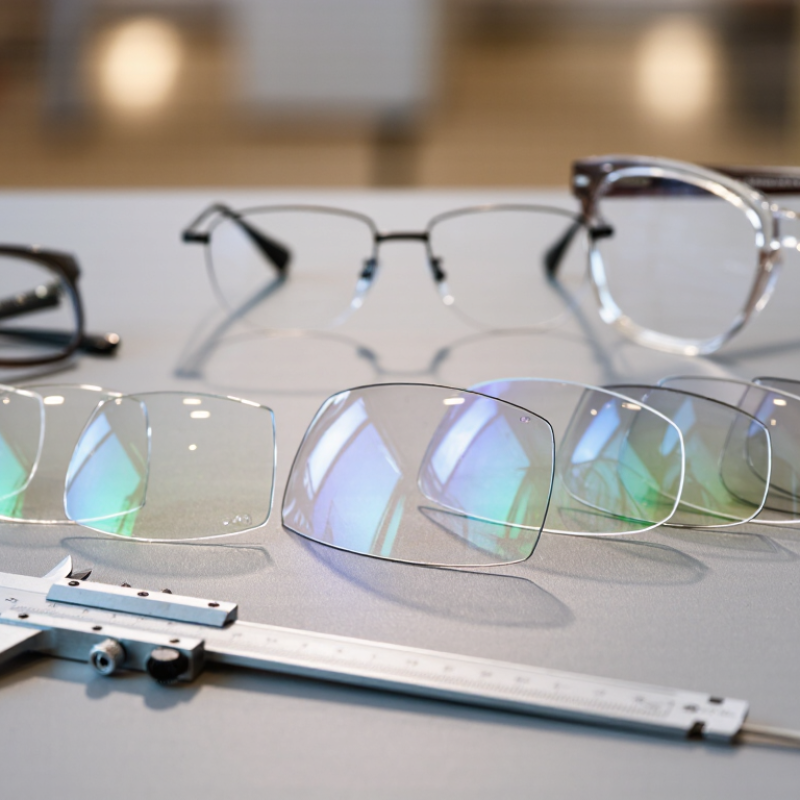
Top 10 Types of Ultra High Index Lenses to Buy
Ultra-high index lenses have refractive indices from 1.67 to 1.74. This number shows how efficiently lens material bends light. A higher index usually creates a thinner lens for the same prescription. The 1.67 option suits many moderate prescriptions. The 1.74 option may benefit stronger prescriptions, especially with larger frames. Thin is not everything. High-index materials can reflect more light and may show stronger color fringes. Professional anti-reflective treatment is therefore important. Common choices include single-vision, progressive, bifocal, occupational, photochromic, polarized, blue-filtering, aspheric, digital-relief, and impact-resistant designs. Availability depends on the prescription and lens laboratory.
In practice, accurate measurements matter as much as index. Pupil distance, fitting height, frame shape, and vertex distance affect comfort and visual performance. Aspheric designs can reduce edge thickness and improve the lens profile. However, they may require careful centering. I once assumed the thinnest lens would always look best. That assumption was too simple. A poorly fitted 1.74 lens can perform worse than a well-centered 1.67 lens. An optician should compare prescription strength, lifestyle, frame size, and optical needs before recommending a material. Lower-index lenses may sometimes provide clearer color perception.
Tips: Choose a smaller, well-shaped frame for stronger prescriptions. Request anti-reflective treatment for high-index lenses. Ask whether the lens includes UV protection. Compare thickness estimates before ordering. Allow time for adaptation, especially with progressive designs. Fit matters.
| Rank | Lens Type | Typical Refractive Index | Typical Abbe Value | Relative Density | Main Design or Feature | Best Suited For | Important Buying Consideration |
|---|---|---|---|---|---|---|---|
| 1 | 1.67 Spherical High-Index Lens | 1.67 | Approximately 31–33 | Approximately 1.35–1.40 g/cm³ | Basic spherical optical design with a thinner profile than standard plastic lenses. | Moderate to moderately high prescriptions, especially for everyday single-vision use. | Usually thinner than 1.60 material, but it may show more chromatic aberration than lower-index materials with higher Abbe values. |
| 2 | 1.67 Aspheric High-Index Lens | 1.67 | Approximately 31–33 | Approximately 1.35–1.40 g/cm³ | Flatter front surface that reduces center thickness and minimizes the magnifying or minifying appearance of the eyes. | Moderate to high plus or minus prescriptions and wearers seeking a slimmer, cosmetically flatter lens. | Precise centration and fitting are important because flatter designs can be more sensitive to optical positioning. |
| 3 | 1.67 Free-Form Digital Lens | 1.67 | Approximately 31–33 | Approximately 1.35–1.40 g/cm³ | Digitally optimized surface geometry that can account for prescription, frame shape, fitting height, and viewing position. | Single-vision or progressive wearers who want customized optics and improved peripheral performance. | Benefits depend on accurate measurements, frame adjustment, and the quality of the optical design. |
| 4 | 1.67 Photochromic High-Index Lens | 1.67 | Approximately 31–33 | Approximately 1.35–1.40 g/cm³ | High-index lens material combined with light-responsive molecules that darken outdoors under suitable ultraviolet exposure. | People who move frequently between indoor and outdoor environments and want one pair for general use. | Darkening speed and final tint depend on temperature, ultraviolet exposure, and the vehicle environment; most car windshields limit darkening. |
| 5 | 1.67 Polarized High-Index Lens | 1.67 | Approximately 31–33 | Approximately 1.35–1.40 g/cm³ | High-index prescription lens combined with a polarizing filter that reduces horizontally reflected glare. | Prescription sunglasses for driving, boating, fishing, snow activities, and bright outdoor conditions. | Polarization reduces glare but may make some LCD screens harder to read at certain angles; it is generally intended for sunwear. |
| 6 | 1.70 Aspheric High-Index Lens | Approximately 1.70 | Approximately 36–37 | Approximately 1.40–1.45 g/cm³ | Very high-index aspheric design offering a thinner profile while retaining a somewhat higher Abbe value than many 1.67 and 1.74 materials. | High prescriptions where lens thickness and cosmetic appearance are important. | Availability varies by prescription range and lens design; anti-reflective treatment is strongly recommended. |
| 7 | 1.71 Aspheric High-Index Lens | Approximately 1.71 | Approximately 36–37 | Approximately 1.45–1.50 g/cm³ | High-index aspheric geometry designed to provide a thin lens with a balance between optical clarity and thickness reduction. | Moderately high to high prescriptions, particularly when a thinner alternative to 1.67 is desired. | Lens availability and minimum fitting requirements can differ; accurate pupillary distance and fitting-height measurements are essential. |
| 8 | 1.74 Spherical Ultra-High-Index Lens | 1.74 | Approximately 32–34 | Approximately 1.45–1.50 g/cm³ | One of the highest commonly available ophthalmic lens indices, providing substantial material-based thickness reduction. | High to very high prescriptions where minimizing edge or center thickness is a priority. | Higher index does not eliminate thickness completely; frame size, lens shape, prescription power, and optical center placement still have major effects. |
| 9 | 1.74 Aspheric Ultra-High-Index Lens | 1.74 | Approximately 32–34 | Approximately 1.45–1.50 g/cm³ | Ultra-high-index material combined with a flatter aspheric surface to reduce bulk and improve cosmetic appearance. | Very high minus prescriptions and high plus prescriptions requiring the thinnest practical lens profile. | Because 1.74 materials generally have lower Abbe values than many lower-index options, premium anti-reflective treatment and careful fitting are valuable. |
| 10 | 1.74 Lenticular or Bi-Focal-Form High-Index Lens | 1.74 | Approximately 32–34 | Approximately 1.45–1.50 g/cm³ | Specialized geometry that concentrates the prescription in a central optical zone, helping reduce the apparent size or thickness of very strong prescriptions. | Extremely high prescriptions that cannot be adequately optimized with a conventional full-aperture design. | The usable viewing area can be smaller, and the appearance and performance depend heavily on the prescription, frame, and fitting measurements. |
Note: Ultra-high-index ophthalmic lenses are generally defined here as materials with refractive indices from 1.67 to 1.74. Abbe values, density, available designs, and performance can vary by material formulation and prescription. Actual thickness depends on prescription power, frame size, lens shape, pupillary distance, and fitting position.