10 Essential Tips for Choosing the Right Spherical Lenses
Choosing the right spherical lenses is crucial for various optical applications. These lenses can greatly affect image quality and clarity. With numerous options available, it can be challenging to select the perfect pair.
When considering spherical lenses, think about the specific purpose. Different activities, such as photography and sports, demand unique lens characteristics. Not all lenses fit every need. Be mindful of the material and coating. Quality can vary significantly among brands.
Many people overlook these details. Rushed decisions may lead to regret. It’s essential to evaluate your requirements. Take your time to find lenses that truly enhance your vision. Reflect on how you use these lenses in your daily life. The right choice will improve not just visuals, but experiences.
Understanding Spherical Lenses: Key Definitions and Types
Spherical lenses are crucial in various applications, from eyewear to cameras. Understanding their types and definitions can guide your choices. A spherical lens has a surface shaped like a segment of a sphere. They can be convex or concave. Convex lenses are thicker in the middle, while concave lenses are thinner. This characteristic makes each type suitable for different purposes.
When choosing spherical lenses, consider the purpose. Are you using them for everyday eyewear or scientific applications? This clarity helps narrow your options. Look for the lens curvature. The curvature affects the focus and magnification. It also influences how light passes through.
Pay attention to the material as well. Different materials provide various levels of durability and optics. Make sure you assess coatings too. Anti-reflective and scratch-resistant coatings can enhance the lens's performance. Remember that quality can vary, so do your research. Think about comfort as well. Poorly chosen lenses can lead to discomfort and visual strain. Finding the right fit requires patience and experimentation.
Importance of Lens Material: Polycarbonate vs. Glass in Optics
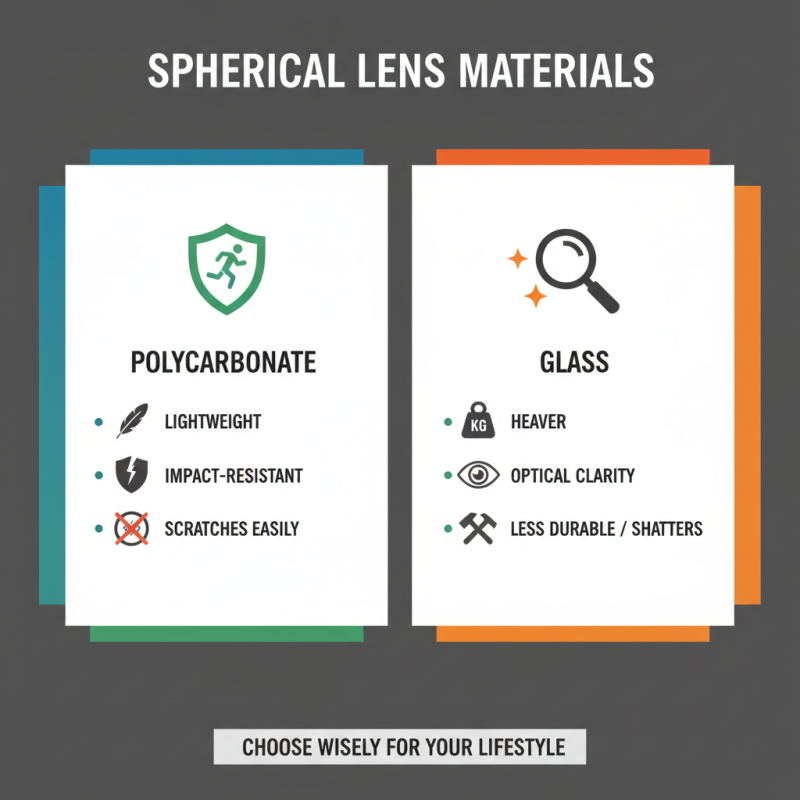
When choosing spherical lenses, the material is crucial. Polycarbonate and glass are the two most common options. Polycarbonate is lightweight and highly impact-resistant. This makes it a popular choice for active lifestyles or safety glasses. Its durability is impressive, but it can scratch easily if not cared for properly.
On the other hand, glass lenses have excellent optical clarity. They provide superior vision correction. However, glass is heavier than polycarbonate. This can be uncomfortable for extended wear. It’s important to weigh these factors carefully. Some people prefer the look of glass, but the practicality of polycarbonate can’t be ignored.
Another point to consider is your environment. If you work in a rugged area, polycarbonate may serve you better. Conversely, if you’re in a controlled setting, glass might be worth the extra weight. Ultimately, think about your lifestyle and preferences. There isn’t a one-size-fits-all answer. Each material has its pros and cons, so the choice requires reflection.
Assessing Optical Quality: Analyzing Aberration and Clarity Metrics
When selecting spherical lenses, optical quality is crucial. Aberration can distort images. It can manifest as blurriness or color fringing. Evaluating clarity metrics ensures a sharper image. Analyze how the lenses perform in various lighting conditions. Check for consistency in quality across the entire lens surface.
Consider the first tip: test out lenses in real-world situations. Not all environments offer the same clarity. You may notice imperfections in poor lighting. Don’t overlook this aspect, as it could affect your experience.
Another essential aspect is checking for reports on distortion. Users may share insights into how lenses perform. Look for reviews that discuss specific use cases. These experiences can be telling. They reveal how lenses function outside controlled settings. Be mindful that even well-regarded lenses can have flaws. It’s essential to be critical when assessing your choices.
Optical Quality Metrics for Spherical Lenses
This chart illustrates the optical quality metrics for spherical lenses, highlighting key factors such as aberration level, clarity score, light transmission, distortion, and reflection. These metrics are essential for evaluating the overall performance and suitability of lenses for various applications.
Determining the Correct Diopter: Measuring for Accurate Prescription Lenses
When it comes to choosing the right spherical lenses, understanding diopter measurements is crucial. A diopter measures the lens's power. For most people, a prescription between -1.00 D and -6.00 D is common. Studies indicate that about 15% of the population requires prescription lenses within this range. Getting it right means avoiding headaches and eye strain.
Measuring accurately for a prescription involves several steps. Using a pupillometer can aid in getting precise measurements of the distance between your pupils. This measurement, known as PD, is essential for proper lens alignment. Incorrect PD can lead to distortion in vision.
Tip: Always consult an eye care professional for an accurate assessment.
An indoor test can help too. Use a printed test card with varying sizes of text. This helps gauge how well you see at different distances. If you struggle to read the smallest line, it’s time for a new prescription. Remember, even small errors in measurement can significantly impact your visual comfort.
Tip: Regular check-ups are vital as vision changes over time.
Using digital tools has improved measurement accuracy, but it’s still important to have a consultation. Ultimately, prioritize comfort and clarity over aesthetics in lens selection. The right choice can transform how you experience the world.
Coatings and Treatments: Enhancing Durability and UV Protection in Lenses
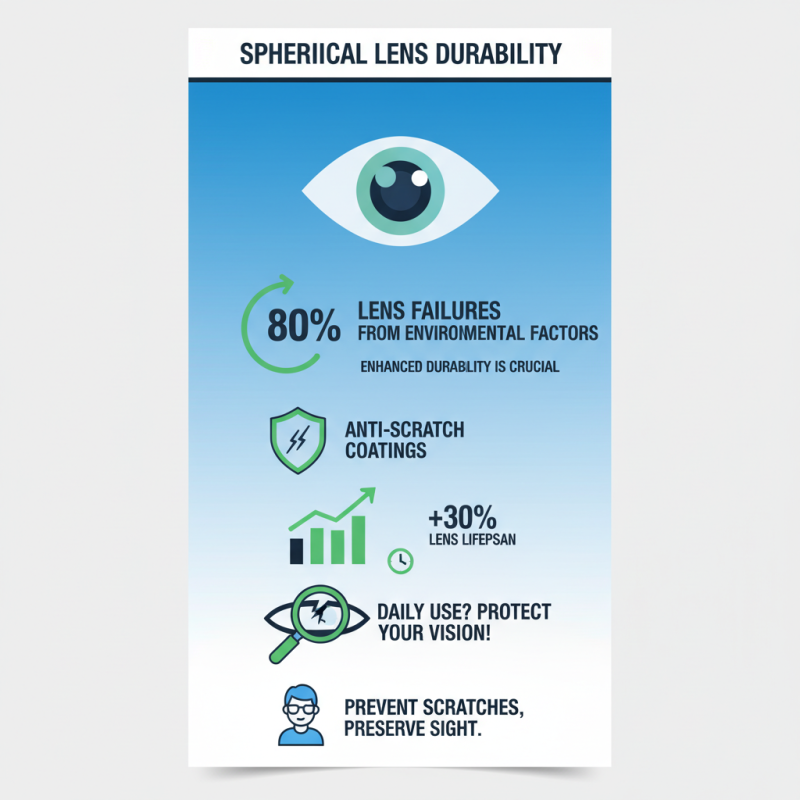
When choosing spherical lenses, coatings and treatments play a crucial role. A significant 80% of lens failures occur due to environmental factors. Thus, enhancing durability is essential. Anti-scratch coatings are common. They can increase lens lifespan by up to 30%. This is vital for individuals who use lenses daily. A simple scratch can lead to significant vision problems.
UV protection is also crucial. Harmful UV rays can cause cataracts and other eye conditions. Lenses with proper UV coatings filter out 99% of harmful rays. This offers peace of mind for outdoor enthusiasts. Reports indicate that 40% of people neglect UV protection in their lens choices. Awareness is needed. Yet, many consumers remain unaware of the importance of these features.
Anti-reflective coatings reduce glare, improving clarity. They can enhance light transmission by 8-10%. This is beneficial when driving or during computer use. However, not everyone understands the full benefits of these treatments. Many still choose lenses based solely on price. Education about the benefits could help consumers make informed decisions. Enhancing durability and UV protection in spherical lenses should be a priority for every user.